
Part 1
Surrounded by America’s fertile farmland and food manufacturing industry, one family’s experience with food insecurity and how it’s changed over decades
A mother
Mom was in the house cleaning when Dad walked in holding a diamond ring.
He had dirt on his shoes, clothes, and hands. Mom stopped and propped her left hand on the broom handle. She already wore a wedding band—a ring Dad had fashioned for her from a polished brass nut while working nights at the FMC plant in Hoopeston, Illinois. A placeholder until he could afford a real one.
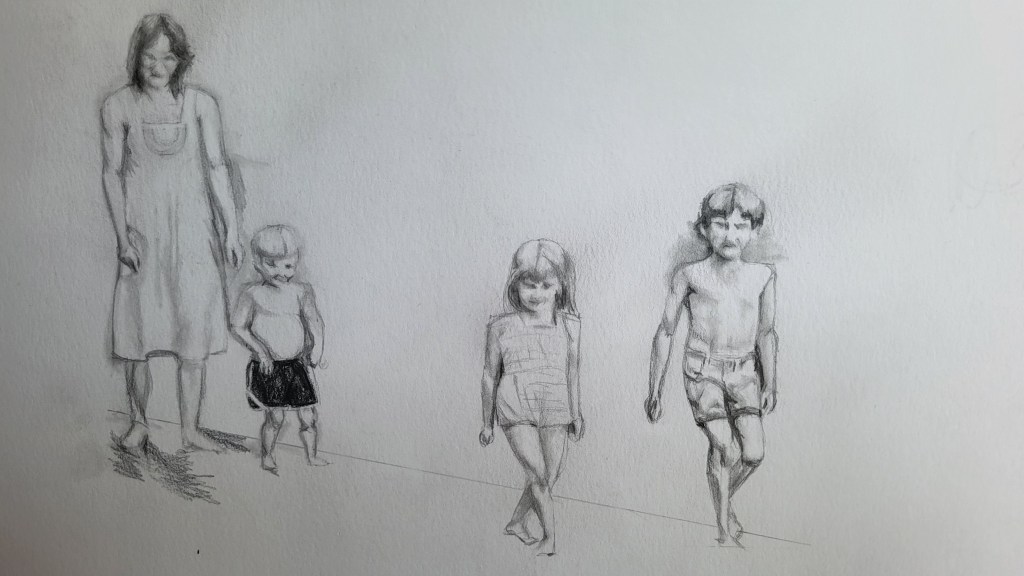
They’d already been married six years. We had just moved into the new house, a nondescript white bungalow at the corner of First Avenue and Maple Street with an enclosed porch that faced a large shipping building and railroad tracks. My two brothers and I were running around the house somewhere, probably playing in unpacked boxes. This was Mom and Dad’s third house together, and the first home I remember. I have a vague recollection, not of moving, but of the experience of familiar objects in an unfamiliar place.
First Avenue, back then, was a brick cobblestone road. After thunderstorms, Mom would sometimes take us out to walk barefoot in the soft currents that overflowed along the curb. I can still feel the warm water on my feet, the fine silt under my toes.
Hoopeston in the 1980s was a town of about 6,000 people, known for two things: sweet corn (and its somewhat controversial sweet corn beauty pageant) and farm manufacturing. For those who care (and if you’re in the Big Ten, you probably do), it is the hometown of Ohio State’s winningest basketball coach, Thad Matta.
For me, Hoopeston’s most enduring legacy is its Carnegie Public Library, a white classical revival building with portico entrance. I remember it with teal carpeting and immense ceilings in the main rooms. There was a downstairs area for the children’s section with beanbags, not-too-tall stacks, and kid-size stations to listen to books on cassette.
Hoopeston had been an affluent town, at one point even boasting an opera house, and was written about once in the “New York papers” because its aldermen refused to accept payment for their work.
Canning and manufacturing plants were the large employers in town. Pillsbury, Teasdale, and Chiquita had all run operations in Hoopeston. Silgan Containers, whose brands have included Campbell’s, Green Giant, Carnation, and SPAM, still operates a factory there. Most Americans (at least 97 percent, according to most numbers) consume food packaged by one of these types of plants. It seemed everyone we knew was either a farmer or a factory worker.
“It was a big deal when your dad got hired on as a welder at FMC,” Mom told me. In 1984, Dad’s salary was twice the national minimum wage. He welded on just about everything that came through its doors: fire trucks, air cargo, orange juice and conveyor equipment, among others.
FMC got its start making pesticide spray pumps and occasionally got contracts from the government to make military vehicles. In 1985, FMC purchased the world’s largest lithium producer. Eventually, FMC separated its machinery and chemical divisions and shut down the Hoopeston plant. Today, FMC focuses entirely on chemical agricultural science and is the fifth-largest company in the “crop protection” market.
And still, almost every summer, Dad would get laid off. Mom had started factoring his unemployment into the budget as much as she did his $7 an hour. Mom would sometimes do odd jobs when she could, or occasionally went back to work as a veterinary tech at Dr. John Knight’s office, a job she got when she was in high school. But during this particular layoff, Mom and Dad had a new mortgage (and an 18 percent loan rate).
A ring
Dad had been outside removing the old picket fence to replace it with a new chain-link. In fact, the chain-link fence, I learned, wasn’t purchased for the new house, but taken from their old house on Elm Street. The concrete had barely dried when they got the foreclosure notice, so Dad ripped it out to install it at the new house on First. Not exactly the squarest of deals, now that I know how homebuying works, but now that I’ve had a few homes of my own, I can understand why somebody would want to keep a home improvement they’d just paid for and never got to enjoy.
Dad had been working on the fence all morning. He had made it around to the front of the house near the sidewalk, wiggling a post loose to remove the gate. Finally, he squatted, bear-hugged the 4-by-4, and gave it one last oscillation before he heaved it up out of the ground.
Something shiny fell.
Dad thought it was a dime at first. He laid down the post, grabbed a handful of dirt – and the ring.
“It was a decent size diamond,” Dad recalled.
His first thought was to give Mom the ring to replace the one he’d made for her. But Mom loved that ring. She didn’t want a different one.
“It looked like a real gold ring,” Mom said. (So real that someone stole it years later.) Besides, she had more important plans for this small treasure find.
Dad’s first unemployment check hadn’t arrived yet. At this point, they were praying they’d be able to pay for food that week. Mom was pragmatic, and resourceful. This was, after all, the very same woman who owned one pressure cooker all the way through my childhood and into my adult life, even after parts had fallen off and she had to use pliers as the handle.
America’s hunger
She had been making the food budget stretch for years. In 1984, average food costs were 15 percent of Americans’ take-home pay. Today, despite rising food prices, the amount of income spent on food has dropped to 11 percent, and the amount spent on dining out has gone up. At the time, my parents’ food budget was probably closer to 30 percent of their income.
“Having a garden definitely helped,” Mom said. “Also access to surplus foods in the fields. Farmers were okay with neighbors gleaning after harvest.”
Gleaning has been around for centuries, a construct of the “commons” and even a dictate from God in Leviticus (or, as Mom points out, Ruth): farmers shalt not “gather any gleaning of thy harvest: thou shalt leave them unto the poor, and to the stranger.” But the practice was almost put in jeopardy by private property laws before it experienced a comeback after the 1960s. Some farmers still hesitate for fear of liability and loss of insurance, but those are federally protected against.
“We bought our meat from our farmers and had a freezer full of meat and garden stuff,” Mom continued. “Everybody shared their surplus with others. Grandma and Grandpa canned lots of beans, so we always had a stock of that. The farmers we knew were doing good at that time until the big shift of corporate farming.”
Since the Great Depression, farmers had been subsidized as part of an emergency recovery program. But the subsidies never stopped, and those farms eventually were bought up and became corporate agribusinesses. Now a majority of the subsidies goes to a small minority of capitalist beneficiaries. Almost all of the money goes toward commodity crops; some to cattle and livestock; and one percent for fruit, vegetables, and whole grains, according to a Yale report.
“We didn’t have a diverse menu…. We ate what was available and on sale.”
Mom
“I stocked up on items we always used and only bought when they were on sale. We didn’t have a diverse menu plan as we do now. We ate what was available and on sale.”
Meatloaf. Pork chops. Zucchini. Mashed potatoes. Zucchini. Peas. Hash. Zucchini.
And Jell-O.
“When it was on sale I stocked up,” Mom said.
This explains my memories of the gelatin fruit salads. None of the fancy/bizarre/grotesque “centerpieces” you might find in retro cookbooks or nostalgic blog posts. No. Jell-O was in a major sales slump, and Jigglers were still a few years away, so for us, this was cheap, easy dessert.
Mom would make a simple red-strawberry or green-lime Jell-O in a square dish, then add a can of mixed fruit to it – the grapes and cherries were my favorite – something to fill our bellies more than just sugar and water. I’d repeatedly open the refrigerator door before it had set to shake the pan to see if it was ready.
As a mother now myself, I am surprised by the amount of effort and thought that goes into the day-to-day task of keeping a child fed, and my sense of pride when my son hoovers a meal I made.
I try to imagine what it was like for Mom, who had three kids, two of them ravenous boys, to make enough food for all five of us a few times a day. Making Jell-O for a pre-bedtime snack was probably the only thing Mom could do to keep us from going to bed hungry.
But Mom wasn’t – and isn’t – alone in her struggle to feed her family.
In the 1980s, at least 20 million Americans didn’t have enough food to eat, according to the documentary “A Place at the Table.” Today, the organization Feeding America puts that number at more than 50 million. After the Reagan tax cuts in the 1980s, most of the responsibility of feeding poor families fell to food banks, charities, and local communities.
Most of us have heard of food deserts by now, but we’ve been led to imagine inner cities and the single-mother stereotype, which is only partially true. In the United States, “9 out of 10 counties with the highest food insecurity rates are rural,” the Feeding America website says, exacerbated by lack of transportation, greater distances to grocery stores with fresh fruits and vegetables, lower wages, and higher prices. (The Consumer Price Index, or CPI, we read about in most media only accounts for urban pricing, not rural.)
Even today, my parents have experienced insufficient access to food. Mom has driven more than an hour away from their house in Reedsport, Oregon, to buy food she can’t find or is too expensive in a small rural town. She says they are the fortunate ones.
They also take advantage of the local food bank, not because they need to, but because a member of their church volunteers and can’t stand to see any food wasted, so my parents get large bags of Starbucks coffee and other items, depending on what comes in. In April, food banks across the country were told hundreds of millions of dollars in funding had been cut by the federal government. These funds also tended to support local farmers and provide fresh produce to recipients.
Mom complains that she can’t grow a garden where they live on the coast because of inadequate space, high winds, and cool temperatures, so the advice to plant a garden doesn’t work. Finally, after years of looking in an impractical Oregon housing market, Mom and Dad finally bought a home in the Willamette Valley, closer to stores and medical care. They’re already at work putting in a garden.
Food insecurity in Douglas County, Oregon, where they live on the coast, is 15.4 percent, a little more than the 14.3 percent of Vermillion County, where Hoopeston is located. Both close to the national average.
But what is food insecurity?
Many would define it simply as hunger. But the USDA goes out of its way to clarify food insecurity as “without hunger.” In fact, in 2006, although the parameters are the same, the government made the distinction between food insecurity and hunger – and then it also removed “insecurity” from its terms, so that now there are four levels of food “security”: high, marginal, low, and very low. Low and very low used to be considered food “insecurity.”
Even by the older standards, my family would have been classified “food secure” (marginally): “anxiety over food sufficiency or shortage of food in the house. Little or no indication of changes in diets or food intake.”
Mom and Dad eventually took the ring to Unger’s Jewelry on Main Street, where they got $80 for it. They bought groceries that week, and the unemployment check arrived soon after.
It would take another three years before Mom would get her ring.
*Author’s note: I chose to start these Portraits with my mom because, logistically, interviewing her was easy. But I also knew writing about family honestly can be hard. But I also decided to start here because as I’ve grown older, I’ve wanted to know my mom as a person outside her role as “Mom” – and also because I believe she has led a diverse and interesting life.
 Peggy Perdue