First, a big thanks to my Founding Sponsor
Former educator turned Top 5% Realtor Jessica Tammaro blends high-level professionalism with a down-to-earth, positive approach, bringing expertise and heart to every deal. She is dedicated to making the home-buying process seamless, stress-free, and is particularly passionate about empowering women and educators to achieve homeownership and wealth through real estate.

A brother’s accident. Their parents’ divorce. A family separated. How one day can impact the rest of our lives.
Part 3
Read Part 1: A mother, a ring, and America’s hunger and Part 2: The bride wore plaid.
Mom remembers looking back home from on top of her horse and seeing dark smoke coming from the garage.
It was summer. 1973. Mom had just turned 14. She’d be starting high school in the fall and was looking forward to some measure of freedom, time with friends, and of course, riding her horse Kiowa. “Every hour I wasn’t at school I was on that horse,” Mom said.
She kicked her heels against Kiowa and galloped home. When she got there, her sister Carol, 12, was standing in the driveway with their brother, Bob, who was 10 or 11 years old at the time. He was shaking, and Mom could see large blisters on the backs of his arms. A neighbor who saw the smoke called the fire department and rushed over.
Bob was taken to a Chicago hospital two hours away and spent most of the next year recovering from the burns. He had been in the garage, “tinkering with something,” Mom says. She doesn’t remember. She can’t recall where her parents were or if her youngest sister, Leslie, was around, it was so long ago. Yet so much has rippled from that day.
“I lost my home, family. After my brother got burned, everything changed.”
The rest of that summer, Mom said, she and her sisters were “shipped off” to live with a variety of family while her brother recovered—with their mom, who had moved to Chicago to be near the hospital; their dad, back home in Wellington, Illinois; an uncle in South Carolina; grandparents in Indiana. Sometimes it was fun—playing with cousins, going to the beach.
Then came the news that their parents were getting a divorce. They sold their house and acreage in Wellington, and got rid of most of the horses except two: Mom’s and Leslie’s horses. Mom’s dad moved to nearby Hoopeston, close to where he worked. Her mom stayed in Chicago.
That fall, Mom and her sisters got “yanked” out of school and away from their friends in Wellington and moved to Arlington Heights, a suburb of Chicago. Mom enrolled at Forest View High School, where she didn’t know anyone. Her sisters were in middle and grade school.
Her mom was gone a lot. Once, she was gone for days, so Mom went out to look for her. When her mom did come home, she never said where she had gone or why.
When Mom’s dad visited, they would visit the Brookfield Zoo. Mom remembers her brother getting better and starting to join them on these outings. Mom would beg her dad to let them come back home.
After nearly a year, Mom got her wish. But when Mom and her sisters moved back in with their dad, their brother was still in Chicago, and it wasn’t back “home” to Wellington, but Hoopeston, where Mom had to adjust to yet another new high school. “Everyone had their cliques,” Mom said. “I didn’t fit in with the farm kids.”
Then her parents decided to split the four kids between them. Carol and Bob lived in Chicago with their mom; Mom and Leslie stayed in Hoopeston with their dad.
“I lost my home, family,” Mom said. “After my brother got burned, everything changed.”
Mom said she skipped school, fell in with the “wrong” group, started drinking and doing drugs, and barely graduated. Mom stopped riding and sold her horse Kiowa.
In interviews, Mom repeatedly said she had wished an adult—her parents, a teacher, anyone—had helped her, stepped in, done something. She admits, looking back now, that some people tried—a couple of classmates, a teacher, her sister, even. Her dad did what he could, but “he had his own problems,” Mom said.
It’s a delicate time for teenagers, and an important time for parents; 14-year-olds crave independence, but still need—and actually want—guidance and support. Friends are extremely important and strongly influence behaviors and actions. The brain, especially the self-control regions, are still developing. A lot is going on mentally, physically, emotionally. Today, doctors screen for depression and eating disorders at well-checks around this age. In fact, some questions a doctor might ask today, according to the American Academy of Pediatrics, are, “How’s school going? Have there been any big changes in your life? And do you have at least one parent you can rely on?” But this was the ’70s, and Mom remembers only going to the doctor if she was sick or injured and the occasional vaccination.
Mom had always been the responsible one. When she got her first “job” picking rocks out of a farmer’s nearby fields, she saved every dime (literally—”I think it was actually a dime,” she said). As the eldest child, she was tasked with keeping an eye on her brother and sisters. If they did something wrong, she would get in trouble for not keeping them out of trouble. When her mom wasn’t home, she’d have to cook dinner, which was usually rice, because it was all she knew how to make. She got a job at a restaurant when she turned 16 so she could buy her first car, a white 1970 Maverick. Later, when she had her own family, I remember her cleaning constantly. And we weren’t allowed a lot of sugary foods around the house, except an occasional “pop” (it was the Midwest, after all) when we went out for Monical’s pizza or watched a movie at home on TV or our cousins came over to visit.
So the idea of Mom being the black sheep was hard to imagine.
Mom had been happy in Wellington, Illinois, a rural village bisected east-west by Main Street and north-south by a railroad line. They had only lived there a few years, moving from Chicago when Mom was 10, to keep her and her siblings “out of trouble.” In the ’70s, Wellington’s population peaked at about 400; today that number has been cut by half. When Mom talks about it now, more than 50 years later, the word “good” comes up a lot.
“It was a good place to be. Good families. Surrounded by good people,” she said. “Wholesome. Even my parents were normal. They tried to get along.”
It was in Wellington that Mom started to take notice of how families behaved and treated each other, when she started to form a vision of “how they ‘should’ take care of and respect each other.” How other families were “different” from her own. One of Mom’s friends lived in a “quiet” house; Mom’s parents argued a lot.
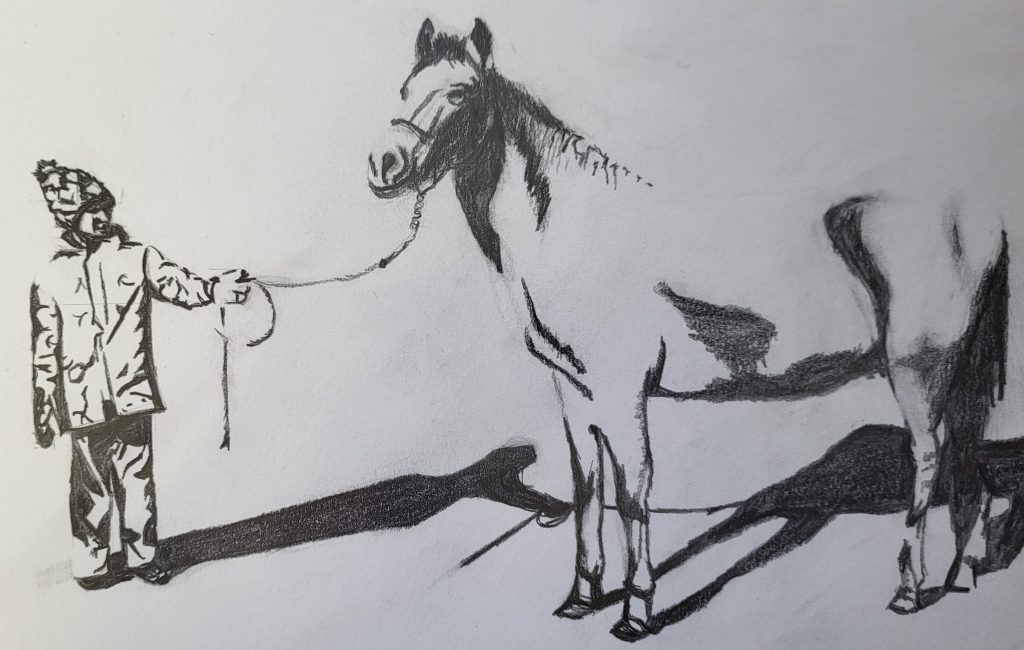
Wellington was also where her love of animals sparked. One of Mom’s friends had horses, and Mom wanted one, too. Her mom had always wanted them. They lived on a large enough property, so within a year, Mom had Kiowa, a Dun quarter horse mix with light coat and dark mane and tail.
Mom joined 4-H and started competing. Then one horse became 15 horses, “because my mom can’t just do anything a little bit,” Mom said. They tried showing horses and breeding them. “It didn’t work, because we didn’t know what we were doing.” Kiowa wasn’t a purebred, so Mom never could win against the kids who could afford them, but she could win in the riding competitions.
It was Mom’s love of animals that helped pull her out of what she now says might have been a depression. After the divorce, when Mom was at high school in Hoopeston, the local veterinarian, Dr. “Jack” Knight, was looking for help. Dr. Knight’s daughter, one of Mom’s classmates, encouraged her to apply. So she did.
“I was so excited,” Mom said. “I didn’t want to get my hopes up.”
She got the job. For nearly three years, after school and during the summers, Mom worked as a vet technician, cleaning, organizing, learning clerical work and the brand-new computer systems, doing just about everything she was legally allowed to do, even assisting in some surgeries. But most of her work was with Dr. Knight’s wife, who managed the office.
“I tell ya, that’s where I learned how to clean,” Mom said, answering an unspoken question, disproving my theory that she must have been born with the cleaning gene that had skipped over me. “She was very picky. And once a week we were closed half the day, and that was the day, I mean, I went and I had to scrub corners, everything. I was on my hands and knees cleaning, and if it wasn’t to her specs, I had to go back and do it again. She was strict. But I liked her. She taught me a lot. I think it was because of her I learned the things I did and I was able to move on and get other jobs that otherwise I wouldn’t have known how to do. It might have changed the trajectory of my life.”
It was also Mom’s time at the vet’s office that gave my childhood a bit of its Doctor Dolittle (the 1980s edit) whimsy. When I was 11, we found a baby owl in the road by our house. Mom put on her work gloves to pick it up, examined it, kept it on the porch overnight, then released it. We also occasionally kept cattle for neighboring farmers and got to see a live calf birth, took in a baby racoon for a while, there might even have been a skunk somewhere along the way. And of course, there was almost always a new litter of kittens and at least one dog.
Mom eventually owned horses again, too. She taught me and my brothers how to ride them, brush them, feed them so that they didn’t bite our fingers. We learned how to clean their hooves: stand with our shoulder against their legs, run our hands down along the knee and cannon, until we wrapped our fingers around the fetlock and pastern to get them to lift their hooves. And we learned how to walk around behind them and not get kicked.
Mom, whether she knew it, liked it, or not, is a nurturer. (It also just so happens her numerology life path number is 6, symbolizing home and responsibility.)
“I don’t know if it’s natural,” she says. “I never thought about it.” If you ask her what she’s most proud of, she says her family and how we kids turned out, but even then, she demurs. “I can’t take credit for that.”
On Mother’s Day 2014, I got a call from Mom early in the morning. Not too early, but early enough to get out of bed and answer. “Hey,” I said in a hoarse whisper as I tiptoed down the hall, though I’m sure my husband was already awake.
Mom and Dad had been at the hospital all night.
When they went to bed the night before, Mom’s head felt “full,” as if she had been standing on her head. Then every muscle got tight and her arm started moving. A little at first, then faster, jabbing my dad in the back. Dad rolled over and was about to tell her to knock it off. “I thought she was petting Kitty,” he said. But their cat wasn’t in the room.
Mom was having a seizure.
Dad called the ambulance, and the EMTs arrived before Mom came to, “wide eyed and disoriented,” she said, “with some strange man looking at me.” They examined her, told her what had happened. She didn’t remember anything after her arm tightened. She could tell she bit her tongue, and her calves felt sore, like she had gone for a long run. The whole thing—from going to bed to the ambulance arriving—took around 15 minutes. Then they went to the hospital and Mom got an MRI.
A golf-ball-size tumor in her brain.
Meningiomas are the primary brain tumors, usually benign, making up more than a third of all cases and affecting about 5 percent of the total population. Women are twice as likely to get them than men. They typically go unnoticed until a person is older, usually by accident while screening for something else, or if symptoms actually show, such as seizures. They’re found in the outer layers of tissue between the skull and brain, tend to grow slowly, and have well-defined edges, which make them operable.
But in Mom’s case, her tumor was also butted up against a blood vessel that runs through the center of the brain. They could do surgery, but the neurosurgeon cautioned she probably wouldn’t be able to remove all of it. Mom was prescribed a seizure medication, sent home, and scheduled for surgery a couple of weeks later. Her sister Leslie flew out a couple of days later but had to leave before the surgery.
The next couple of weeks before the surgery went on without incident. But Mom started to notice she felt “irate and impulsive.” She’d feel anxious, angry, and want to act out, side effects of the seizure medicine. (Later, after the surgery, Mom asked, but her doctor wouldn’t take her off it, so Mom gradually took herself off, which is not recommended, but she started to feel more like herself.)
Mom’s sister Carol came out for the surgery. At the hospital, before they took her in to the operating room, we got to see Mom, were told what to expect and that she’d probably just have a pretty bad headache afterward. Then we took turns comparing the surgeries we’d all had and which one was worst. And we laughed about Mom’s hard head and warned the surgeon that she would have trouble getting through Mom’s skull (she did; she had to ask for a second tool), then we went out to the waiting room and sat for eight hours until we could see her again.
When Mom got home, she slept nearly the entire week. She had patches of hair sticking out of the bandage and we finally convinced her to shave the rest of her hair off. Her sister Carol left a few days later.
Nobody had been able to reach her brother Bob.
The last time anyone in the family had seen my Uncle Bob was in 2010, at their dad’s funeral. Before that, Mom saw Bob in 2008, while he was training for his CDL and happened to be driving through Southern Oregon, where my parents lived at the time. It was a visit that sticks out in Mom’s mind.
“He seemed well,” she said, “and relaxed. It was a short visit but good.”
I remember my Uncle Bob used to visit more when I was younger. Then occasionally. Then less and less. Until not at all. The last time I saw him was nearly 20 years ago on his wedding day. The marriage ended a few years later.
Mom has made comments over the years that she thought the burns had affected him beyond just the physical recovery and pain, and he had been in and out of trouble with drugs. People recovering from burns can experience depression, anxiety, sleep disturbance, grief; and the first year after hospitalization carries high stress. Today, families may undergo counseling to help cope with the physical, social, and psychological changes that come after burns. In the long term, many people continue to deal with social stressors, vivid memories, lower self-esteem, and a perceived decline in the quality of life.
A few years ago, Mom heard Uncle Bob was working in the shipping department at a store in Mesa, Arizona, and last Thanksgiving, when I had planned to publish this Portrait (I delayed in the hopes of writing a happy ending, or some conclusion to the now decade-long search), my parents drove through to try to find him, but Mesa, a suburb of Phoenix, was bigger than they realized, and there wasn’t enough time before they had to continue on their trip for the holidays.
In recent years, there has been an increase in media coverage of family estrangements, spurred often by social media posts of people going “no contact” or, more recently, celebrity family reconnections. It has been covered on everything from FOX to the New Yorker to NPR, even Vogue. Some, like Oprah, say the “trend” is on the rise, but there’s no evidence of that—at least not according to psychologists who have been studying it for several years. Typically, what we seem to be seeing is the uptick in people talking about it, and how. Plus, each person’s degree of separation from their family ranges considerably. In his book The Power of Parting, Eamon Dolan discusses how family estrangement has evolved, guided by his own story of separating himself from his mother.
You can read more about Family Estrangement on my Topics page…
I’ve started a Topics page, where I’ve included some of what I consider the best and more thorough resources on family estrangement, and I’ll add to with other issues I’m writing about. I’ve also made it a point not to include what I consider unhelpful sites, especially those that are clickbaity and seem to stress the drama over depth (although I confess it’s hard even for me not to want to share the numerous stories out there that make my shoulders tense and my jaws clench—but that’s also a clear signal to me to move on).
In the United States, family estrangement, when a person limits or cuts off contact with siblings or parents, is somewhat common, affecting nearly one-third of the population. Estrangement from parents, often abusive or in situations where a child was expected to grow up too fast and take on adult responsibilities too young, is most common. But sibling estrangement is less common, only about 5 percent, according to some reports, and is often a byproduct of cutting off ties with a parent.
My uncle’s estrangement from Mom and the rest of the family is somewhat rare, at least in my research for this piece. I even hesitated to characterize it as such, but it seems to fit the definition. However, even more rare is that my uncle’s estrangement has grown to the point that Mom has contemplated contacting local law officials to help find her brother.
In a phone call with the local police department where Bob was last known to live, they said filing a missing person report would be the next step, which would allow them to get him in the system and at least be able to report back something if they found out. And yet, “missing” doesn’t seem to fit either, though it’s now been at least a year since confirmation of his whereabouts. I’ve also had a difficult time finding any other situations where “family estrangement” blurs the line with “missing person,” or if this actually is a more common stage in the entire process, but there is some evidence of it.
Mom had planned to try to look for Uncle Bob again earlier in the new year (and again I delayed this story in hopes), but a doctor visit sidelined those plans. She learned that her tumor had grown, and two new ones appeared, about 3 cm each. She went in for a less invasive radiosurgery procedure to try to shrink them using a GammaKnife. There have been no complications to report. She goes back in a few months to see if it worked.
Mom hasn’t decided whether to file a missing person report on her brother.
“I worry about him,” she says. “But I worry about what will happen if I find out he needs help.”
Dear reader,
Thank you for being here. It’s been one full year since I officially launched Portraits. As I begin my second year, I’d love to hear from you: What is it about these stories that attracted you, and makes you want to keep reading? And if you’re a subscriber or contributor, what makes you want to support this work?

